



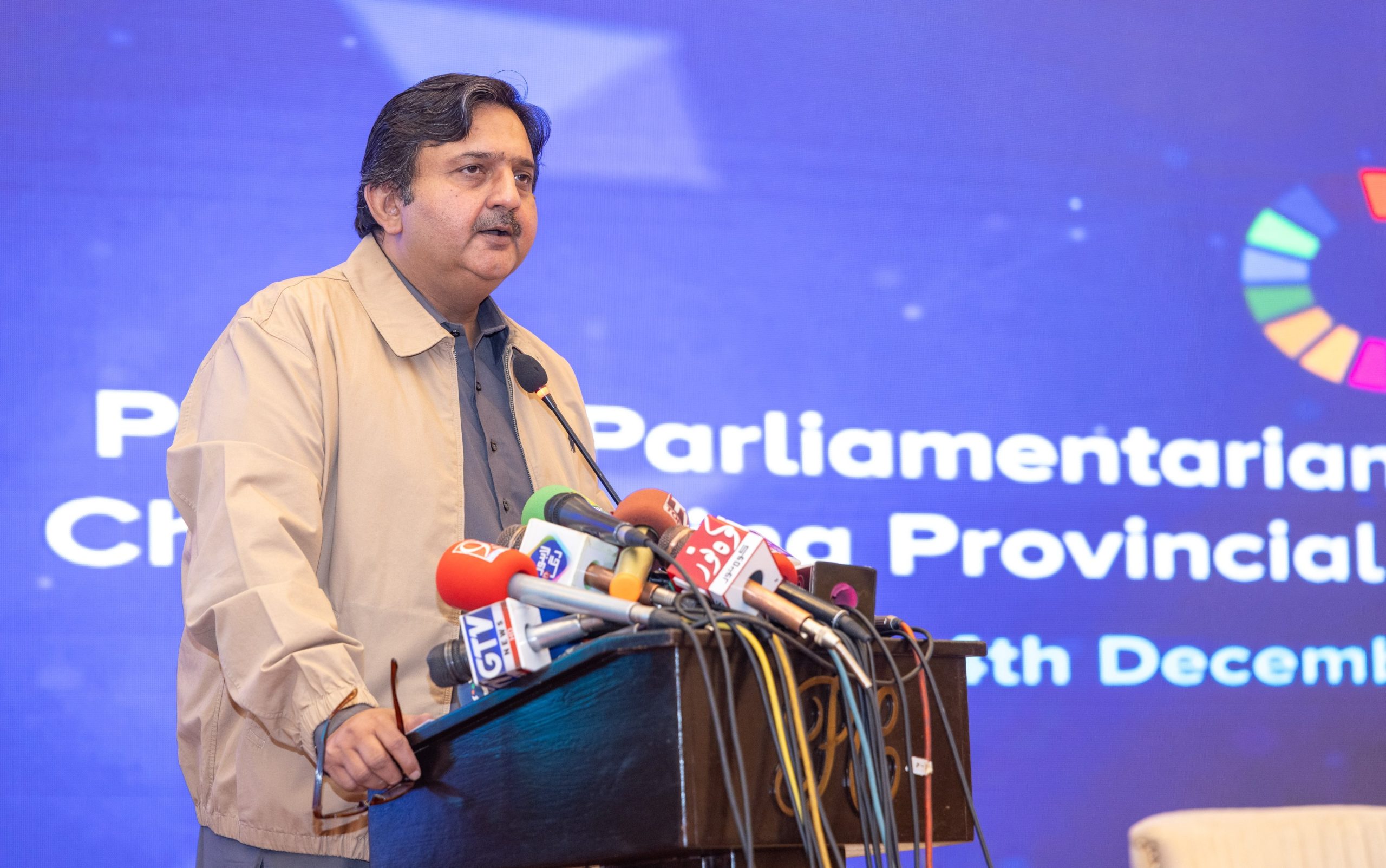
The second session of the Punjab Parliamentarians Conference on the sustainable development goals – Championing provincial action for Agenda 2030 – held at the Pearl Continental Hotel in Lahore in collaboration with the Punjab Assembly and the UN Development Program (UNDP), marked a transformative moment for Pakistan’s parliamentary engagement with the UN-backed sustainable development goals.
The conference represented the first time that a provincial government led a national initiative, bringing together legislators from all legislative houses — Senate, the National Assembly, and all four provincial assemblies — onto one platform dedicated to advancing the Agenda 2030. The energy throughout the session reflected a growing momentum and vibrance around sustainable development, signaling a new era of provincial ownership of the SDGs in the years following the 18th Amendment, where provinces increasingly define, shape, and drive Pakistan’s development priorities.
A milestone achievement of the conference was the presentation of the Parliamentary Accord on the SDGs—the first document in Pakistan to emerge from collective, cross-provincial parliamentary deliberations on sustainable development. Drafted by a board of young parliamentarians from the Punjab Assembly’s SDG Task Force, it is a consensus-based, domestically-produced document that reflects shared national aspirations and inter-legislature solidarity. The accord signifies a turning point: a unified parliamentary voice on SDGs, rooted in provincial realities and anchored in Pakistan’s own institutional experience, rather than external frameworks.
Its development — and the Punjab Assembly’s central leadership in convening the conversations that shaped it — demonstrates how provincial legislatures are increasingly becoming the engine rooms of Pakistan’s policy transformation. The session began with remarks by Asifa Khan, Director of the Parliamentary Development Unit (PDU) of the Punjab Assembly, whose team played a pivotal role in structuring the conference, building partnerships, and supporting the Task Force. She set the tone for a day defined by substantive dialogue and forward-looking commitment.

This was followed by an overview from PILDAT President Ahmed Bilal Mehboob, who presented the 2025 SDG performance for South and East Asia, Pakistan’s regional position, and the crucial role of parliamentarians and standing committees. He acknowledged the leadership of the Speaker Punjab Assembly for elevating parliamentary engagement with the SDGs. UNDP Senior Adviser Naveed Ahmad Sheikh elaborated on the broader vision of the Agenda 2030, underscoring the importance of inclusive development, evidence-based policymaking, and institutional coordination.
He reaffirmed UNDP’s commitment to supporting the Punjab Assembly in localizing and accelerating the implementation of the goals. Building on this, another official from the UNDP Development Policy Unit highlighted the progress made across provinces in improving data systems, aligning policies with the goals, and strengthening institutional capacity. She outlined a forward roadmap centered on innovative partnerships and new approaches to speed up implementation. Legislators then took the floor in an interactive plenary, reflecting the diversity of provincial voices and constituency-level experiences that enrich Pakistan’s SDG journey.
Sultan Bajwa, Parliamentary Secretary for Housing, Urban Development and Public Health Engineering, spoke about social welfare priorities. MPA Uzma Kardar emphasized that meaningful national progress hinges on empowering women and girls, appreciating both the Punjab Assembly and UN Development Program for shaping this conversation. Parliamentary Secretary for Environmental Protection Kanwal Liaquat drew attention to climate-related challenges and the need for interdepartmental collaboration, particularly highlighting the use of satellite technology for monitoring forests.
MPA Adnan Afzal Chattha raised concerns about children excluded from schooling due to poverty, and noted how investments in skills — such as training in the hospitality industry — are contributing to economic growth. Public Accounts Committee-II Chairperson Ahmed Iqbal Chaudhary spoke about climate change, floods, and extreme weather events, and highlighted that 170 members of the Punjab Assembly were under the age of 45, a powerful sign of renewed youth leadership. MPA Amna Hassan Sheikh discussed women’s protection and its link to SDG progress, while MPA Sara Ahmad spoke about rehabilitation centers for children, and the pressing issues of child beggary and trafficking.
Public Accounts Committee-II (H.I.) Chairperson Syed Ali Haider Gilani shared his work on the Thalassemia Bill and thanked the Punjab government, the speaker, and fellow members for their support. UNDP Resident Representative Samuel Rizk emphasized that the conference was not only a learning forum but also a call for stronger parliamentary oversight. He underscored that understanding the SDGs must go hand in hand with the ability to track, evaluate, and accelerate progress.
Senior Minister Marriyum Aurangzeb concluded the session by reflecting on how far Pakistan has come in embracing the SDGs. In 2013, She recalled that awareness was limited, whereas today, the SDGs were understood as a comprehensive national development framework that connects ministries, institutions, and partners. She commended the Punjab Assembly and the Parliamentary Development Unit for their leadership, acknowledged UNDP’s role as a key development partner, and reaffirmed the SDG principle of ensuring that progress includes everyone and leaves no one behind.

Overall, the 2025 Punjab Parliamentarians Conference established a new benchmark for provincial leadership in the national development. By convening legislators from across Pakistan, generating the country’s first consensus-based Parliamentary Accord on the SDGs, and activating a vibrant, youth-driven legislative discourse, the Punjab Assembly has demonstrated its capacity to lead with vision, coherence, and ambition. This initiative has infused the SDG agenda with renewed political energy, institutional commitment, and national alignment—setting the stage for a more coordinated and inclusive path toward achieving Agenda 2030.