

Media professionals, including journalists and content creators, acknowledged that readers are fully experiencing and enjoying a concept of a participatory journalism that encourages users to read, share, comment, and engage in news, creating a more open and accessible flow of information.
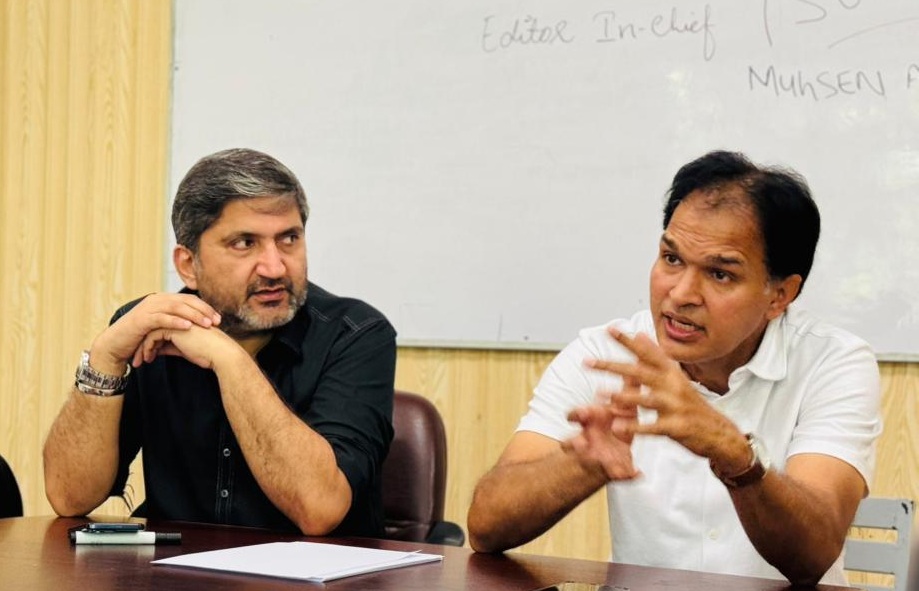
This was stated by journalist Muhsen Ali Turk while speaking at a workshop, organized by the Department of Journalism of the Punjab University’s School of Communication Studies in Lahore, as a guest speaker. Associate Professor Dr Shabbir Sarwar also shared his opinion about multiple phases of journalism, especially the print media and its transformation from print to digital format, during the workshop – News Writing and News Editing.
School of Communication Studies Director Prof Dr Abida Ashraf, and Department of Journalism Chairperson Prof Dr Mian Hanan Ahmad also joined briefly the event. Muhsen Ali Turk, a former Senior Vice President of the Punjab Union of Journalists (PUJ), and former Governing Body member of the Lahore Press Club (LPC), also shared his print and digital media experience with the audience, and said that journalists in Pakistan were trying to maintain their presence in the current flow of information.
“Everyone can easily observe a ‘flood of information’ along with some misinformation and some disinformation, but these are the journalists and media professionals who are trying their best to differentiate between what is right and what is wrong. For me, the journalists are doing their job fantastically despite the fact they are facing a lot of problems in their personal life,” he said before the start of the interactive session. The participants were the students of the four-year BS Journalism Studies.

Just like other journalists, the guest speaker started the workshop in a direct engaging way rather than a ‘traditional’ or somehow a ‘formal’ way to start a workshop with already-prepared presentation. Firstly, he introduced himself and asked all the students to introduce themselves one-by-one as they were seated in an oval-table where they can easily understand and communicate with the guest speaker. After the introduction session, this was very much clear that the audience was inclusive due to their ethnic and linguistic diversity.
Muhsen Ali Turk, founder and Editor-In-Chief of the Risala Today – a daily English language newspaper that focuses mostly on Pakistan and Pakistanis, also shared with the students that how they can contribute in the field of journalism soon after completing their degrees from their universities. “There is always a vast space for newcomers as well as fresh content creators in the field of journalism. So, be ready for your next assignment in the media field if you have a good knowledge, information and the interesting way to share your story,” he told the audience.
“If you are following the core values of journalism, then there is a lot of freedom both inside and outside the newsrooms,” he told a questioner about the working of a reporter and editors. “I believe that a journalist may be a ‘biased’ person in their personal life, but their news stories must be free from prejudice, favor or any kind of influence,” he told another questioner. “We have to understand first how to report an incident, accident, briefings, statements and press conferences, besides coverage of the events,” he said, adding that the media persons must be careful while reporting about different ethnic and religious minorities.
To another question, the guest speaker told the audience that an ‘in’visible pressure, legal threat, and economic fragility can be the main reasons that were disturbing the editorial independence. “For some reason, yes journalistic freedom is now facing significant challenges,” he said, and suggested that the journalists in current scenario must upgrade their selection of words, and be careful about propaganda, misinformation and disinformation, launched by certain group(s) to create disturbance in the society. He also shared real life stories from his professional life, and personal experiences.

“I really appreciate arrangement of this workshop for providing the students with hands-on experience of a journalist and updated us practical skills that bridge the gap between academic theory and the media industry,” Farha Jee, the girl representative of the class, said after the workshop. “We learn to create content while following the core values of the journalism, as well as developing critical thinking skills,” said Sameer Khan, the class representative.