

Punjab University Reader’s Society, a student-run literary organization in Lahore, arranged an online session – A ‘new’ wave of Pakistan-India tension and a way forward – with London-based political analyst and journalist Saqlain Imam over tense situation in South Asia in the wake of a ‘false flag operation’ in Pahalgam area of disputed mountainous state of Jammu Kashmir.
During an hour-long discussion and later a powerful question-answer session, the political analyst shared his opinion about what he says ‘ups and downs’ in relations between Islamabad and New Delhi. He suggested both the South Asian neighboring states to focus on development, peace, and prosperity and try to improve life of their citizens instead of draining energy and resources on worthless conflicts.
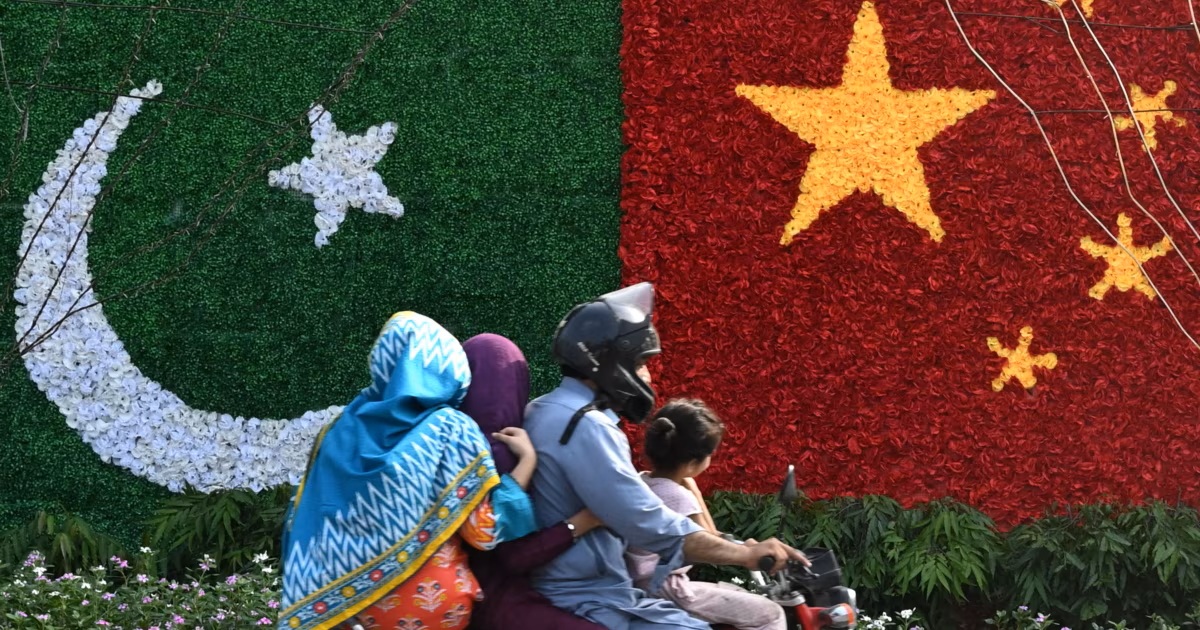
The students asked questions after questions for deeper insights over past and current level of Indo-Pakistan tension; mood swings of political leadership in Islamabad and New Delhi; media coverage; role of journalists and the media houses on both sides of the border; China and its influence besides a key role of young people to calm down the ‘war hysteria’ through the optimistic use of various platforms of the social media.
Saqlain Imam, a journalist with over 40 years of experience, told the young audience about the Indus river system that includes the Indus River and its major tributaries – Jhelum, Chenab, Ravi, Beas, and Sutlej. “We must remember that Indus river system belongs to Pakistan by all rights,” he said, adding that this vital water source was home to the Indus basin irrigation system, one of the largest in the world.
To a question, he said that India’s upstream position on the Indus gives it an ‘upper hand’ but India lies downstream from China on both the Sutlej River and the Indus main stem, as well as on the Yarlung Tsangpo river that flows through China’s Tibet Autonomous Region and India’s Arunachal Pradesh. He noted that India’s aggressive policies to cut Pakistan’s Indus lifeline could prove to be a double-edged sword.
“I am still convinced that Pakistan shouldn’t singed any water treaty with India,” he said while answering a question about the Indus Waters Treaty, signed in 1960 with the World Bank as a mediator. The treaty was an agreement between Pakistan and India that specifies how waters of six rivers and their tributaries will be used by the two neighbors. The treaty outlined the rights and obligations of both the countries for ‘equitable’ use of water flowing in the Indus river system.
Saqlain Imam discussed the pre-independence scenario that how Pakistan and India were divided ‘unnaturally’ along with some ‘fault lines’ which were created by colonizer to hold South Asia unstable for a long time. To a question, he stated that both the neighboring countries have fought three ‘meaningless’ wars due to ills of the partition of 1947. “We have to move forward from the past mistakes, as there are a lot of challenges, as well as opportunities,” he said.
Showing his anger, the political analyst called behavior of India’s Prime Minster Narendra Modi as ‘abnormal,’ and said Beijing will surely support Islamabad if New Delhi was considering kind of support from the United States against its neighbor. He said that India must learn a lesson from Ukraine that acted as a ‘proxy’ of the West-US bloc against Russia. “What happened with Ukraine,” he asked, and warned India to avoid hostility against Pakistan and other neighbors.
“Everyone can see that India is showing unnecessary aggression against Pakistan after another ‘false flag operation.’ I will suggest that Islamabad has to show commitment to prepare for any eventuality from other side of the border,” he said, and asked India to remember that any ‘miscalculation’ can lead to something major – a major war that can be uncontrollable with huge destruction on two sides. “You will be the sole responsible for what will happen,” he told Indian policymakers.
“I have a ‘little hope’ for immediate peace between Pakistan and India due to an aggressive attitude from Indian policymakers,” he said while answering a question. To another query, he said that Pakistan should give a ‘tit-for tat’ response to any Indian aggression. “We must unite and prepare our nation against any aggression,” he said, and suggested the coalition government of Prime Minister Shehbaz Sharif to release all jailed political prisoners without any condition.
About other questions, Saqlain Imam urged the students to work hard in their respective fields and asked the government to focus on the development of human resources to stabilize the national economy. He reminded the students about their role as peacemakers. The organizers informed the guest about aims of the society to promote intellectual grooming besides developing critical thinking among the students of various departments. The society is arranging weekly book sessions both physical and online.