



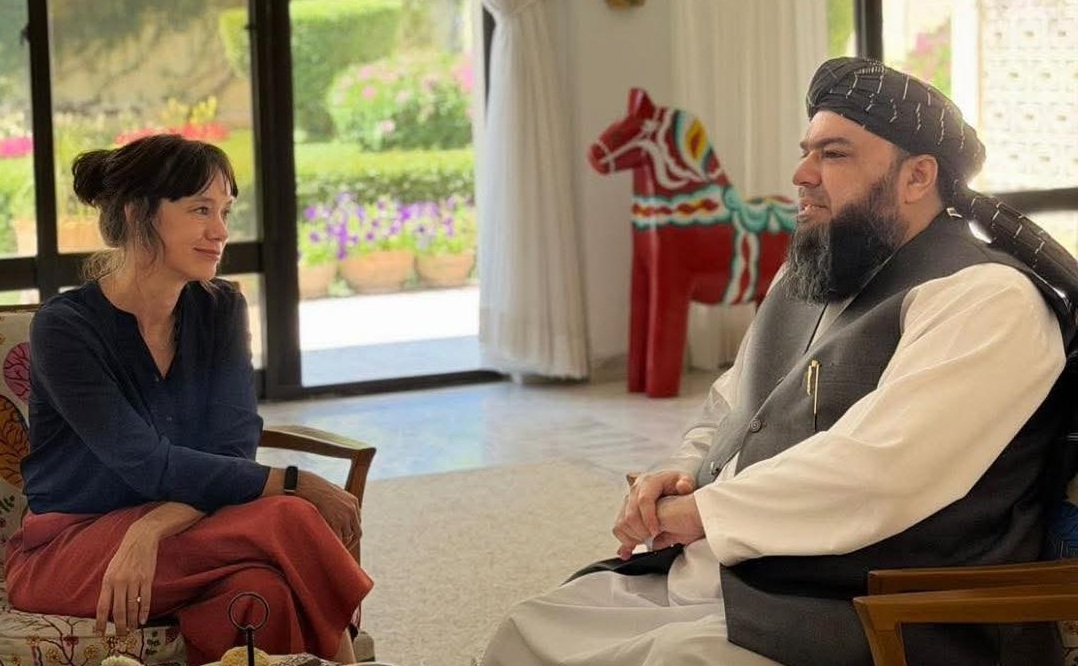
Sweden Ambassador Alexandra Berg von Linde met with Maulana Tayyab Qureshi, chief Khateeb of the Mahabat Khan mosque in Peshawar for #FikaWithFriends – a social media initiative by the Embassy of Sweden in Islamabad, featuring conversations over coffee and cinnamon buns to strengthen cultural ties.
Ambassador Alexandra Berg von Linde and Maulana Tayyab Qureshi spoke about the importance of interfaith harmony, religious tolerance, and the vital need to uphold women’s rights and access to education for girls and boys. The conversation reflected a shared commitment to dialogue, understanding, and building a more inclusive future for all.
Known for his efforts in promoting peace, interfaith harmony, and social cohesion, Maulana Tayyab Qureshi has earned widespread respect across diverse segments of the society. He recently received Tamgha-e-Imtiaz in recognition of his religious, social, and community services. He is among the youngest religious leaders to receive this prestigious national honor, as per the official statement.

According to the Swedish Agency for Support to Faith Communities (SST), approximately more than 225,000 Muslims are registered members of the Islamic communities in Sweden. However, estimates suggested over one million people with a Muslim background settled in the country. As per some information, Muslims in Sweden face challenges regarding Islamophobia and navigating religious practices.
Islamophobia is a significant concern for Muslim residents in Sweden, manifesting through structural racism, increasing public hostility, and high-profile incidents. While the Swedish government has introduced action plans to combat these issues, civil society organizations of the Muslims report a persistent gap between legal protections and their daily lived experiences. Physical attacks on mosques are frequent; research indicates that 59% of Muslim centers in Sweden have experienced physical damage.
In 2024, the Swedish government adopted a new National Action Plan against Racism to combat anti-Muslim racism in schools, the judiciary, and welfare sectors. Recently, the government has shifted from using the term Islamophobia to anti-Muslim racism in official documents to align with European standards, a move criticized by Muslim organizations as marginalizing their own definition of the problem. Critics argue that Swedish courts often individualize these harms, making structural Islamophobia difficult to prove legally.