
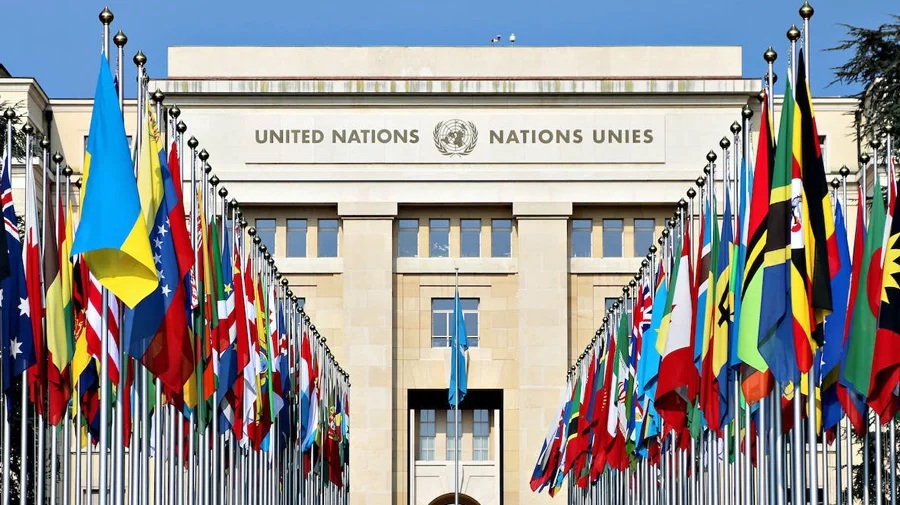
Ambassador Bilal Ahmad, Pakistan’s permanent representative to the UN offices in Geneva, warned India that it will respond with greater ferocity and resolve if aggressed again as he drew attention of the UN Conference on Disarmament to the recent hostilities between the two South Asian nations.
“South Asia does not need another crisis – it requires a future shaped by cooperation, not confrontation,” he told the 65-member forum established by the international community to negotiate arm control and disarmament agreements. “If India chooses path of aggression again, consequences — and the responsibility — will lie entirely at its door,” he said. Pakistan will adhere to the ceasefire, he said.
He pointed out that it’s preference remains unchanged: constructive engagement, result-oriented dialogue, and the peaceful resolution of all outstanding disputes, including the Jammu Kashmir, in accordance with the UN Security Council resolutions. He said that India’s threat and use of force against a neighbor, now in shape of India’s ‘new normal’ poses a serious threat to strategic stability in South Asia.
Indeed, India’s missile, drone, and air strikes on Pakistani territory earlier this month were part of a larger pattern aimed at normalizing the idea that military strikes between nuclear-armed states were acceptable, the Pakistani envoy told delegates. “India seeks to normalize idea that military strikes are acceptable; that military losses are tolerable if political narrative can be managed; that phantom victories can be claimed while real setbacks are denied—even when exposed by global media.”
The ambassador cited a growing list of destabilizing developments: India’s deployment of nuclear weapons at sea, its testing of anti-satellite weapons, canisterization of missiles, and a shift towards a counterforce posture. He noted that these were not contours of credible minimum deterrence but preparation to project power far beyond South Asia. For over a decade, he said that Pakistan has warned this conference of India’s hegemonic mindset and refusal to coexist peacefully with sovereign neighbors.
He said that this mindset has further hardened under the influence of the ruling Hindutva ideology that aims to reconstruct history, demography, and reshape geography. He emphasized India’s recent actions were not isolated but part of a strategic posture that thrives on reckless overconfidence in military imbalance, driven by unchecked violations of international law, hate-fueled populist rhetoric, and delusional expert analyzes. “No other nuclear weapon state behaves with such recklessness,” he asserted.
He pointed out that no nuclear-armed state fires high-speed, dual-capable missiles across international borders into the territory of another nuclear power. The statement also highlighted that India invokes the terrorism bogey to mask its geopolitical ambitions of projecting regional power and hegemony, using military force as a coercive tool of state policy. In this regard, he expressed concern over international permissiveness towards India’s buildup, citing how export control regimes had bent their rules, giving India access to sensitive technologies while holding Pakistan to phantom commitments divorced from strategic realities.
He called upon states engaged in defense cooperation with India to understand and recognize consequences that weapons and technologies they transfer to India today may well be used tomorrow in acts of aggression against civilians and in violations of international humanitarian law. he called on the international community to uphold the UN Charter and support diplomacy over confrontation, stressing that South Asia does not need another crisis. Reacting to Indian delegate’s reference to ‘nuclear blackmail’, a Pakistani delegate said that such self-imposed claims were made to hide India’s own nuclear delinquency.
Professor Cheng Xizhong, senior research fellow at the Charhar Institute in China, called inflammatory remarks of India’s Prime Minister Narendra Modi against Pakistan at a rally in his hometown of Gujarat a dangerous escalation that violated seriously the UN Charter. “I believe that Narendra Modi’s words are mainly due to domestic political considerations,” he said. At present, he said that there was a situation of inflated domestic economic data in India, and the public’s attention to the border conflict has decreased.
He said that the Indian prime minister attempted to shape a ‘strong image’ by making tough statements, diverting domestic attention from economic and other problems, covering up military failures, consolidating his political position, and using extreme sentiment to gain support from domestic voters. In terms of diplomacy, he said that Narendra Modi attempted to boost his influence in South Asia by exerting pressure on Pakistan and demonstrating a tough stance in regional affairs.
In addition, he said that Narendra Modi’s tough rhetoric was also aimed at cooperating with Indian diplomatic missions visiting multiple countries to show the ‘victory’ of the aggressive operations, attempting to make the outside world believe that India has the ‘upper hand’ in the confrontation with Pakistan and pave the way for subsequent diplomatic efforts. Obviously, he said that Narendra Modi’s tough remarks have intensified tensions between Pakistan and India, making the situation in South Asia even more unstable.
He said that India’s announcement to cease the implementation of the Indus Waters Treaty was a declaration of war against Pakistan. It is worth noting that despite repeated expressions of willingness from the Pakistani side to resolve bilateral issues, including Jammu Kashmir and the waters, through peaceful negotiations with India, Narendra Modi once again openly shows off military strength and calls for a war, which goes against the international community’s efforts to promote peace talks, he added.